
Why GRC platforms are less useful now that AI exists
GRC platforms solved the organization problem for compliance teams. But AI solves that same problem and does the actual compliance work too. The value proposition for platforms costing tens of thousands annually is eroding fast when the tedious work they helped you manage can now be done automatically.

What you will learn
- GRC platforms solve the organization problem but AI now solves that and does the actual compliance work too
- The integration promise of compliance platforms delivers roughly 30% automated evidence, 70% still manual
- A Git repository with AI assistance provides better audit trails than any platform dashboard
GRC platforms solve an organization problem. AI solves that and does the actual work too. That’s the shift most compliance teams haven’t processed yet.
For years, platforms like Vanta, Drata, and Secureframe earned their fees by making SOC 2 feel less terrifying. They gave you a dashboard. They broke controls into checklists. They sent reminder emails. Genuinely helpful when the alternative was a spreadsheet and a prayer.
But the thing they were always selling was structure, not execution. The platform never wrote your policies. It never analyzed your evidence screenshots to confirm they showed what they claimed. It never ran penetration tests. It never reviewed whether your incident response plan still matched how your team actually operates. You still did all of that. The platform just kept track of whether you’d done it.
AI does the tracking and the doing. That changes the math on what a GRC platform subscription is actually worth.
What GRC platforms actually do well
Credit where it’s due. These platforms solved a real problem.
Before Vanta and Drata existed, SOC 2 compliance meant an auditor handed you a spreadsheet with 60 to 100 line items and said “fill this in.” You’d spend weeks figuring out what evidence each control needed, where to store it, how to organize policies, and when everything needed refreshing. Most companies doing this for the first time found the ambiguity paralyzing.
Compliance platforms eliminated the ambiguity. They mapped controls to trust service criteria. They pre-populated evidence requirements. They gave you templates for policies you hadn’t thought about yet. They connected to AWS, GitHub, Okta, and Google Workspace to pull some evidence automatically.
The CPA practitioners explain what can and can’t be automated for SOC 2, and the honest answer is that a lot of it still requires human judgment. But at least the platforms told you what to focus on. That’s real value for first-timers.
practitioner analysis of evidence collection puts it plainly: manual collection involves repetitive tasks, Excel sheets, screenshots, and error-prone processes. Platforms reduced some of that pain. Not all. Some.
The problem is what happens in year two. You already know what controls you need. You already have policies. The templates gave you everything useful in the first six months. Now you’re paying five figures annually for what amounts to a reminder system with a dashboard.
The integration gap nobody talks about
Every compliance platform sells on integrations. “We connect to 200+ tools.” “Automated evidence collection.” “Continuous monitoring.”
Here’s what they don’t say loudly enough: those integrations automate maybe 30% of your evidence items. The rest still needs someone to take a screenshot, name it, upload it, and mark it collected.
A platform can pull your user list from Okta. Good. It can check if MFA is enabled across your identity provider. Also good. But can it screenshot your specific firewall rule configuration? Can it capture the settings page of your endpoint protection tool showing the exact policies enforced? Can it document that your quarterly access review actually happened, with sign-off from the right person?
No. Those are manual. And they represent the majority of evidence items for most organizations.
Think about what a typical evidence collection cycle actually looks like. You log into AWS and screenshot your IAM configuration. Then your VPN settings. Then your CloudTrail logging configuration. Then your S3 bucket policies. Then your security group rules. Each screenshot needs a consistent filename. Each needs to be uploaded to the right place. Each needs a timestamp proving when it was captured. Multiply this across every system you operate and you start to understand why “automated evidence collection” is generous marketing for what actually happens.
a compliance practitioner’s analysis notes that integration challenges require custom configuration or manual evidence collection workarounds. The G2 user reviews of Vanta found that users report documents getting lost, auditor alignment issues creating delays, and reporting that lacks depth.
Meanwhile, Drata users on G2 user reviews report unexpected renewal price increases exceeding 150%. So you’re paying more each year for integrations that cover a fraction of what you need.
This isn’t a knock on these companies specifically. It’s a structural limitation. Evidence for SOC 2 is inherently diverse. Some of it lives in APIs. Most of it lives in screenshots, configuration pages, signed documents, and meeting notes that no API can reach.
The platforms promised automation. They delivered organization. There’s a difference.
What AI replaced in our compliance workflow
When we moved off our compliance platform at Tallyfy, the question wasn’t whether we could match platform features. It was whether AI could handle the tedious work that platforms never touched.
Turns out it could. Here’s what our system looks like now, after running through multiple audit cycles.
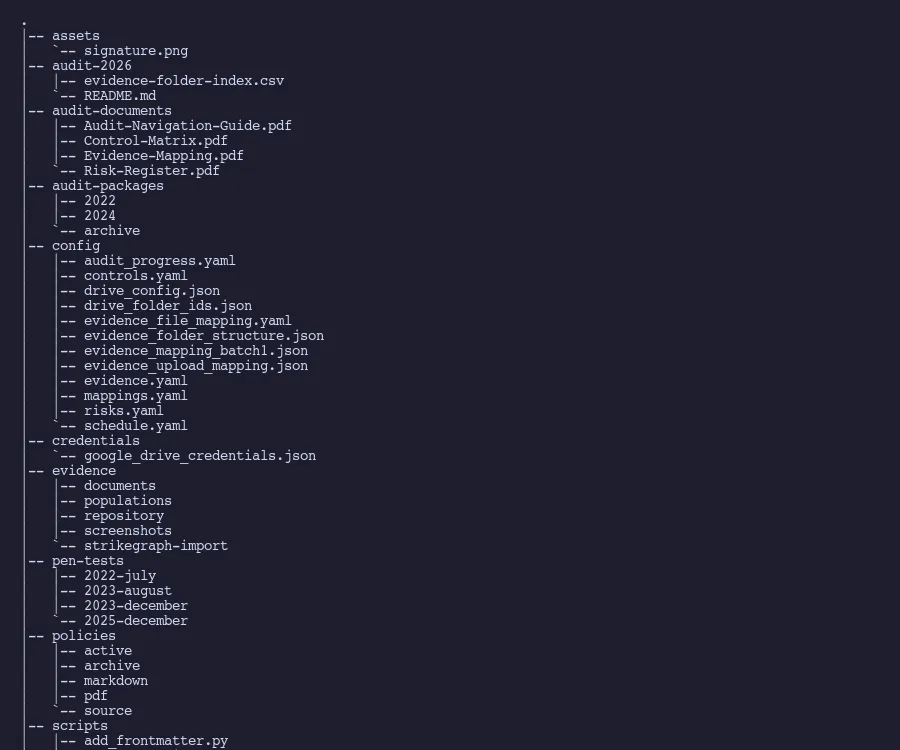
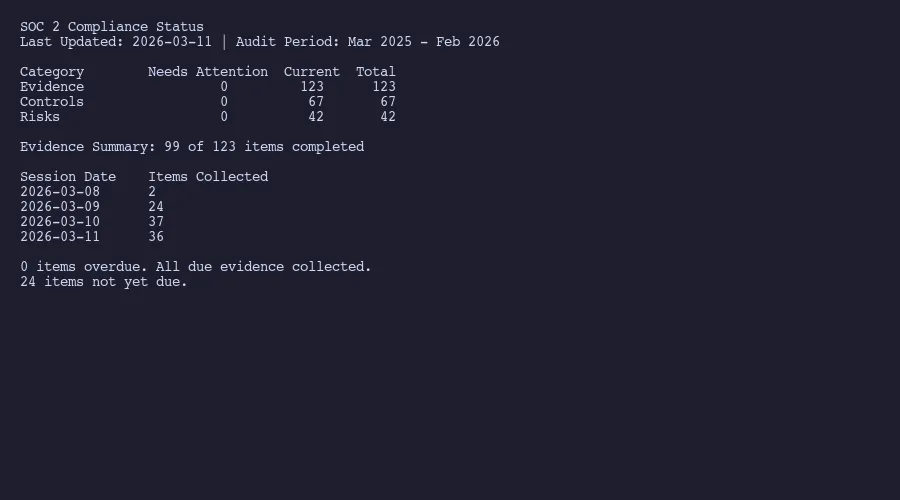
We track 67 controls, 123 evidence items, 151 mappings between them, 42 risks, and 31 policies. All in YAML files in a Git repository. Zero overdue items as of last check. We collected 99 of 123 evidence items in four AI-assisted sessions, using the evidence collection automation workflow we built.
Four sessions. Not four weeks. Sessions.
The AI doesn’t just organize. It reads policy documents and flags sections referencing technologies we’ve changed. It visually inspects evidence screenshots and confirms they show what they claim. It generates professional penetration testing reports from raw scan data, complete with OWASP Top 10 mapping and SOC 2 trust service criteria references.
This is work the platform never did. The platform stored your screenshot. The AI confirms your screenshot actually demonstrates the control it’s supposed to support. If you use Claude Code, we’ve documented what your auditor needs to know about AI coding tools in a SOC 2 environment. The platform reminded you that a policy review was due. The AI reads the policy and tells you what needs updating.
NIST’s OSCAL framework was built on exactly this premise: that compliance data should be machine-readable, version-controlled, and processable by automated tools. Their compliance-trestle project on GitHub treats compliance artifacts as code in a git repository, with CI/CD pipelines validating everything. The direction of the entire field is toward exactly this kind of approach.
We just got there by necessity, not by following a standards body roadmap.
The quarterly rhythm matters. Evidence collection isn’t a constant activity. It spikes around collection dates, audit prep, and policy review cycles. A platform charges you every month for something you intensely use four times a year. AI costs nothing when idle. You pay for compute when you use it and nothing when you don’t. That economics gap widens every quarter.
The feature comparison that matters
This is where platform defenders usually push back. “But the dashboard!” “But the integrations!” Fair. Let’s compare honestly.
| Capability | GRC platform | AI + Git + Drive |
|---|---|---|
| Control tracking | Dashboard with filters | YAML files + scripts |
| Evidence storage | Proprietary cloud vault | Git repo + Google Drive |
| Reminders | Email alerts | Cron job + YAML dates |
| Integrations | ~30% automated | AI-assisted collection |
| Policy management | Templates | Markdown pipeline |
| Audit trail | Activity log | Git history (every character) |
| Pen testing | Not included | Automated monthly |
| Evidence analysis | Not included | AI visual verification |
| Lock-in | Proprietary format | Clone repo, export Drive |
| Annual cost | Tens of thousands | CPA firm only |
Two rows in that table stand out. Pen testing and evidence analysis don’t exist in any GRC platform I’ve evaluated. These are capabilities that only became practical when AI could process unstructured data: images, raw scan output, natural language policies.
The audit trail comparison matters more than most people realize. A platform activity log shows “User X uploaded file Y at timestamp Z.” That’s it. Git shows you exactly what changed in that file, character by character, with a commit message explaining why. Run git blame on any line of any policy and you get the full provenance chain. When an auditor asks “when did this policy language change and who approved it?” you have an instant, verifiable answer. Knowing what your SOC 2 report should contain helps you understand what auditors are actually looking for in these trails. Try doing that with a platform upload log.
The comparison between manual and automated compliance shows that automation reduces preparation time significantly. But the typical framing compares platform-assisted work against purely manual work. It doesn’t address the third option: AI doing the actual analysis and generation work that the platform never attempted.
The gap between “organizes your compliance artifacts” and “does your compliance work” is enormous. Platforms sit firmly in the first category. AI sits in both.
When platforms still make sense
I’m not arguing that every company should rip out Vanta tomorrow. That would be irresponsible.
Platforms make sense when your compliance team has no technical capability to maintain scripts or YAML files. If the person running compliance can’t open a terminal, a platform dashboard genuinely helps. Not everyone has developers willing to build tooling around compliance processes.
They make sense for first-time SOC 2 efforts when you have no idea what’s required. The guided setup, the pre-mapped controls, the policy templates. All of that has genuine value when you’re starting from zero. The platform compresses months of confusion into weeks of structured setup.
They make sense for large organizations juggling multiple frameworks simultaneously. SOC 2 plus ISO 27001 plus HIPAA plus whatever your enterprise customers demand next. The cross-framework mapping features in Drata and Vanta save real time when a single control satisfies requirements across three frameworks. G2 user reviews found Drata particularly strong for multi-framework management, though the pricing model for adding frameworks keeps climbing.
They also make sense if your auditor specifically integrates with a platform. Some CPA firms have workflows built around pulling evidence from Vanta or Drata directly. If your auditor works faster because they know the platform interface, that efficiency has value. Switching costs are real when your auditor relationship depends on a shared tool.
And platforms make sense if you simply don’t want to think about compliance infrastructure. Paying for a managed solution has always been valid when the time cost of building exceeds the monetary cost of buying. Some companies generate enough revenue that the platform fee is noise in the budget.
But here’s what changed. The “build” side of that equation collapsed. AI made the tedious work cheap. Git made the organization free. Google Drive made auditor access trivial. The minimum viable compliance system used to require either a platform or a dedicated compliance person working full-time. Now it requires a repository, some YAML files, and AI sessions every quarter.
For mid-size companies running SOC 2 as one of many operational concerns, the platform is increasingly hard to justify. You’re not paying for capabilities anymore. You’re paying for the comfort of a dashboard that tells you things you could ask AI to tell you instead.
The compliance market will adjust. Platforms will add AI features. Some already are. But they’ll be adding AI on top of a subscription model that existed to compensate for the absence of AI. The foundation shifts when the problem being solved changes from “how do I organize all this?” to “can something just do this for me?”
If you want to explore this for your company, my door is open.
About the Author
Amit Kothari is an experienced consultant, advisor, coach, and educator specializing in AI and operations for executives and their companies. With 25+ years of experience and as the founder of Tallyfy (raised $3.6m), he helps mid-size companies identify, plan, and implement practical AI solutions that actually work. Originally British and now based in St. Louis, MO, Amit combines deep technical expertise with real-world business understanding.
Disclaimer: The content in this article represents personal opinions based on extensive research and practical experience. While every effort has been made to ensure accuracy through data analysis and source verification, this should not be considered professional advice. Always consult with qualified professionals for decisions specific to your situation.